NanoSentry
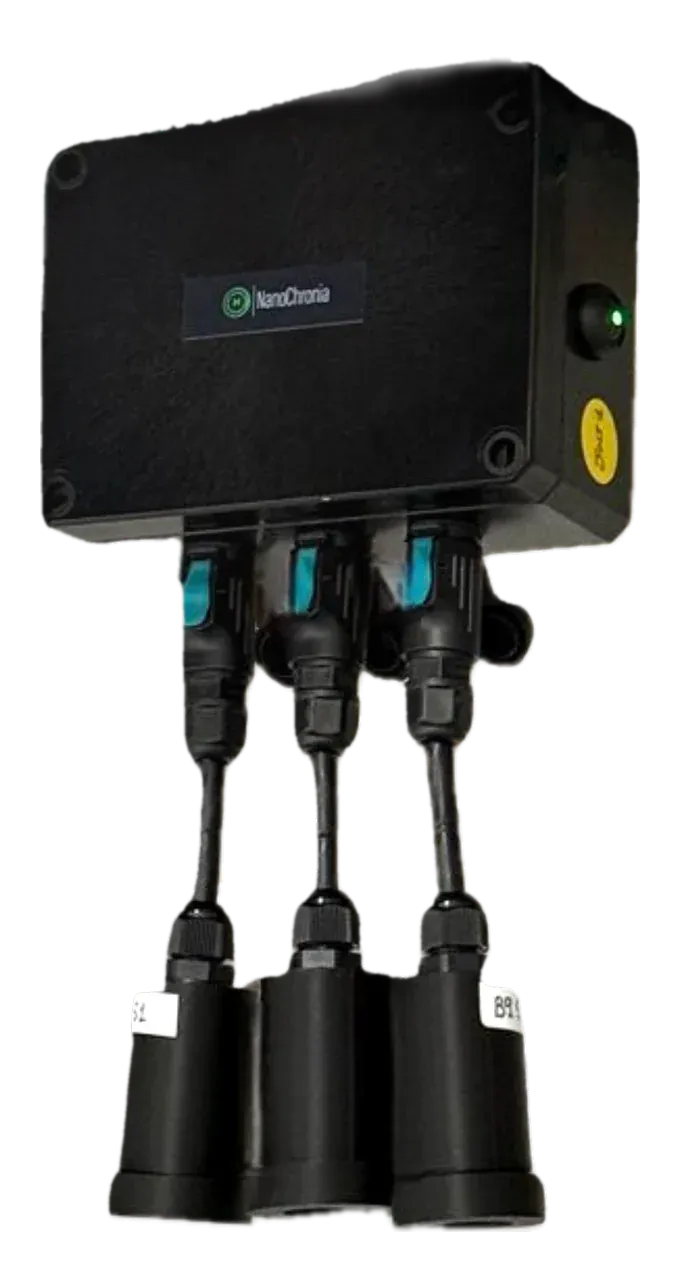
Sensors the size of a chip
A patented IoT system that turns imperceptible molecular-scale physical changes into reliable, continuous, actionable monitoring data.
Nano + Chronia
Sensor hardware and control software, engineered together so every data point is precise, fast and actionable.
Nano — the sensor
Selective and sensitive
Detects molecular-level changes without cross-gas false positives.
Field-proven
Stable performance across varying humidity and temperature.
10x longer lifespan
No consumables or periodic replacements: lower total cost of ownership.
Chronia — the control
Real time, 24/7
Continuous monitoring with closed-loop control, 10x faster.
Predictive analytics
Triangulates the source of a fugitive emission and anticipates maintenance needs.
Traceable data
Full history ready for audits and compliance reporting.
01 · Sensing
MOS and functionalized graphene sensors
At the heart of NanoSentry are metal-oxide semiconductor (MOS) sensors and graphene functionalized with specific receptors. When a gas molecule touches the surface, it triggers a minimal but measurable physical change in the material.
02 · Processing
Proprietary control, precision and stability
A control process patented by NanoChronia stabilizes the sensor reading and filters environmental noise, ensuring response speed and precision even in demanding industrial environments.
03 · Monitoring
Real-time IoT dashboard
Data streams to a dashboard accessible from anywhere, with instant fugitive-emission alerts and historical traceability for audits and compliance reporting.
Roadmap
Where NanoSentry is heading
We keep miniaturizing the hardware, widening gas specificity, improving detection sensitivity and lowering power consumption — so denser sensor networks can be deployed at a lower cost.
What the operator sees when a leak starts
A recreation of the dashboard our customers use: per-node readings, warning and alarm levels, location on the plant and a traceable event log. Let it run for a few seconds.

Hydrogen leak monitoring
Demo plant · Electrolyser hall
Updated
--:--:--
nc-sentry-d1-001
Hydrogen
0ppm
No hydrogen
nc-sentry-d1-002
Hydrogen
0ppm
No hydrogen
nc-sentry-d1-003
Hydrogen
0ppm
No hydrogen
Hydrogen concentration
Real time · last 30 s
Electrolyser hall · plant view
P&ID · EL-200
Active alarms
0
Unacknowledged
0
Nodes online
3/3
Last event
—
Demo running on simulated data. Alarm states follow the usual industrial control-system lifecycle: unacknowledged → acknowledged → returned to normal.
A century of gas detection
From intuition to precise data
The canary
Intuition, no data
Safety lamps
Visual detection
Mechanical meter
Manual reading
Electrochemical sensor
First digital data
Classic MOS sensor
Miniaturization
NanoSentry
MOS layered on graphene, molybdenum and perovskite
Intellectual property
Technology that is protected, not just promised
- Scientific base
Know-how
URV + UPC research groups
- Granted
Sensor control
Patents granted in Spain and the US
- Granted
Graphene/perovskite sensor
Spanish patent granted; national phases in the US, EU, Brazil and Japan
- Granted
Graphene/molybdenum sensor
Spanish patent granted
- Patent
Ammonia sensor
Proprietary patent covering the NH3 sensor
- In progress
Ongoing R&D
New patent applications underway
Gases we detect today
Each sensor is calibrated and validated for a target gas, with alert thresholds configurable to your regulatory or internal policy.
Hydrogen gas
Hydrogen
Key to the energy transition, but highly flammable and colorless. Early detection is critical in production, transport and storage.
Greenhouse gases
Methane
With a warming potential far higher than CO2 in the short term, fugitive methane emissions are one of the energy industry's top regulatory targets.
Toxic gases
Hydrogen sulfide
Extremely toxic even at low concentrations. Early detection directly protects the lives of on-site workers.
Toxic gases
Ammonia
Widely used in industrial refrigeration and agriculture. Corrosive and dangerous at high concentrations, requiring constant monitoring.
Frequently asked questions
What we are asked most often before a pilot.
Which gases does NanoSentry detect?
Hydrogen (H2), methane (CH4), ammonia (NH3) and hydrogen sulfide (H2S). Each sensor is calibrated and validated for one target gas.
How do I access the data?
Through a real-time web dashboard, accessible from anywhere, with every node's reading, alerts on any fugitive emission and the full history for audits and compliance reports.
Can warning and alarm levels be adjusted?
Yes. Alert thresholds are configured for each installation according to the applicable regulation or the site's internal safety policy.
What maintenance does it need?
NanoSentry runs without consumables or periodic replacement parts, which lowers the total cost of ownership compared with technologies that require frequent replacements.
Where is it already running?
On process pilot plants, next to hydrogen electrolysers and inside pig barns, under real humidity, dust and temperature conditions.
How do we get started?
With a scoped pilot at your facility, with no heavy integrations or long-term commitments, to validate detection with your own gases and your own environment.